
For the first time in half a century, there are now white rhinos in Tanzania, a land where they had long vanished. This is the story of how white rhinos have returned to Tanzania, and why they disappeared in the first place.
Rhinos
The rhino family, short for rhinoceros, contains five living species: the white rhino, black rhino, greater one-horned (Indian) rhino, Javan rhino, and Sumatran rhino. Black and white rhinos are found in Africa, whereas the three other species live in Asia.
Rhinos are huge animals, all weighing over half a tonne. Sumatran rhinos weigh approximately 1,300 lbs (600 kg), whereas the largest white rhinos can be over 7,700 lbs (3,500 kg).
Rhinos are known for their iconic horns, which are made of keratin and grow continuously throughout their lives. Javan and greater one-horned rhinos have one horn, whereas all the other rhino species have two. A white rhino’s horn can grow almost three inches every year!

The Difference Between White and Black Rhinos
Although they initially look similar, Africa’s black and white rhinos have distinct differences that can be used to tell them apart. Black rhinos are browsers; they eat leaves, shrubs, branches, and shoots. Because of this, they have a pointed, hooked lip that they use for gripping vegetation, and their head is held higher off the ground.
White rhinos are grazers that feed on grasses with their wide, square lips, and they hold their heads low to reach grass more easily. Black rhinos also have a shorter forehead and smaller, rounder ears, whereas white rhinos have a longer forehead and long, pointed ears. There are also behavioral differences, with black rhinos being more solitary and often more wary, whereas white rhinos tend to be more sociable and generally calmer.
The names of black and white rhinos can be misleading because both species are grey. The white rhino is said to have gotten its name from the Afrikaans word for wide (‘wyd’), referring to its wide, square lip. It’s possible that early English explorers mistook this word for ‘white’ and consequently named this species the ‘white’ rhino, and the other the ‘black’ rhino.
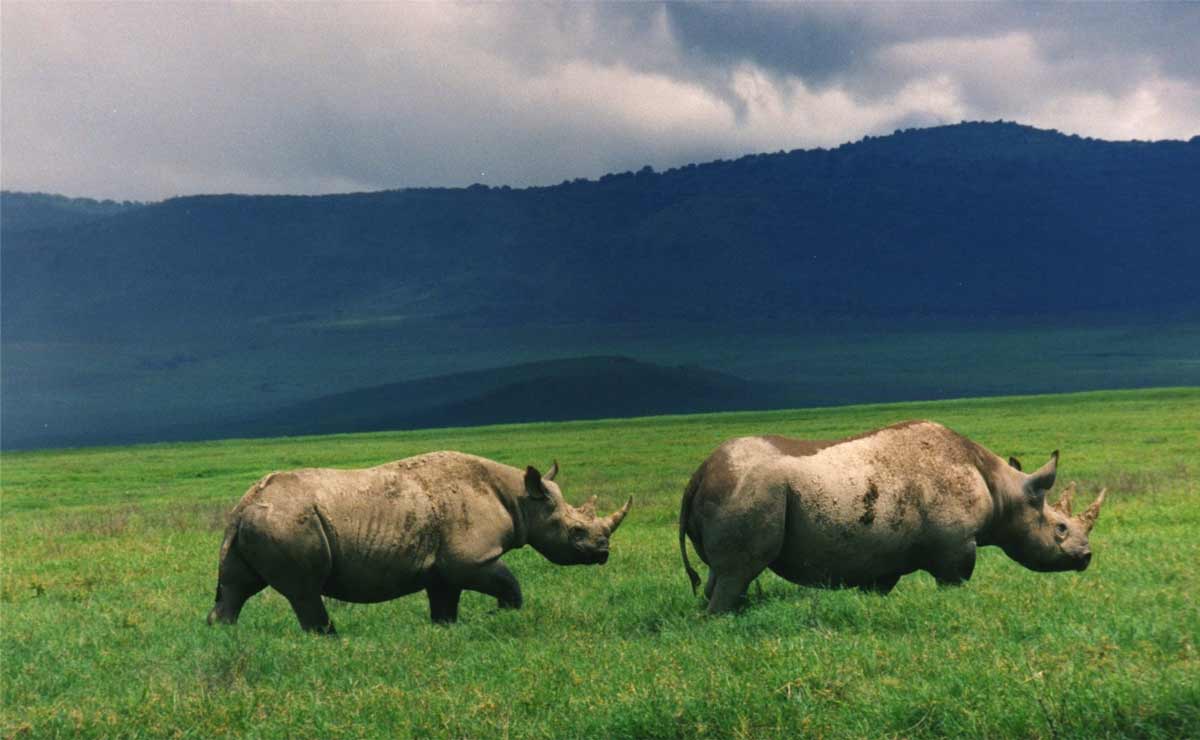
Black rhinos in Tanzania’s Ngorongoro Crater
Rhino Conservation
Rhino Conservation in Tanzania
At one time, there were both black and white rhinos in Tanzania’s vast grasslands. In the 1970s, Tanzania was estimated to be home to 10,000 black rhinos. However, widespread poaching, driven by high demand for rhino horn in the international illegal wildlife trade, decimated the population. By the 1990s, black rhinos were nearly extinct in Tanzania, with estimates that fewer than 100 individuals remained. The story is even bleaker for white rhinos, which disappeared completely from Tanzania in the 1980s.
Dedicated conservation efforts have helped the black rhino population in Tanzania to slowly increase, and a new project has reintroduced white rhinos to the country as well.
The Southern White Rhino Translocation Project
Research has shown that white rhino populations can increase rapidly when living in a suitable habitat and given protection. As poaching, habitat loss, climate change and other pressures continue to threaten wildlife, conservationists are keen to build resilient populations in carefully selected protected areas.
In 2025, 17 southern white rhinos arrived in Tanzania from South Africa’s Munywana Conservancy. This translocation project is a collaboration between a South African wildlife conservancy, safari industry members, and partner communities. This work was supported through a partnership with Tanzania’s Ministry of Natural Resources and Tourism (MNRT) and the Ngorongoro Conservation Area Authority (NCAA). The southern white rhinos involved in this project were donated by the Munywana Conservancy in South Africa’s KwaZulu-Natal Province, a collaboration of private and community landowners that includes &Beyond Phinda Private Game Reserve, Zuka Private Game Reserve, Makhasa Community Trust, and others.
“We are especially proud that, as members of the Munywana Conservancy, we have been able to contribute towards the success of conservation in other parts of Africa,” Thokozani Mlambo, Makhasa Community Trust Chairman.
The 17 rhinos were flown to Tanzania in March 2025, accompanied by a team of translocation and veterinary specialists throughout. After they arrived, they spent over a year in secure, temporary bomas in the Ngorongoro Conservation Area, acclimatizing to their new home. In spring 2026, they were officially released into the Ngorongoro Crater from the initial holding area and are being closely monitored by the Ngorongoro Conservation Area Authority (NCAA) rhino monitors. The group has settled well, and there are now 18 rhinos following the birth of a calf.
The project used a conservation strategy known as assisted colonization. In these types of projects, threatened species are intentionally introduced to suitable habitats outside of their historic range in the hope of improving their future survival. Although southern white rhinos did not historically occur in the Ngorongoro Crater, habitat assessments carried out by Tanzania’s Ministry of Natural Resources and Tourism identified the Ngorongoro Conservation Area as an ideal location to introduce rhinos in Tanzania.
The factors that contribute to the Ngorongoro Conservation Area being a suitable habitat include its extensive grasslands, year-round water sources, strong wildlife protection, and decades of successful rhino management. The Ngorongoro Conservation Area Authority has a solid track record of protecting the globally significant population of critically endangered black rhinos that already live there.
“Initiatives such as these are a proven conservation strategy in ensuring the survival of endangered species such as white rhino, which are increasingly threatened in their historical habitat in Southern Africa,” Tony Adams, &Beyond Conservation & Community Impact Director.
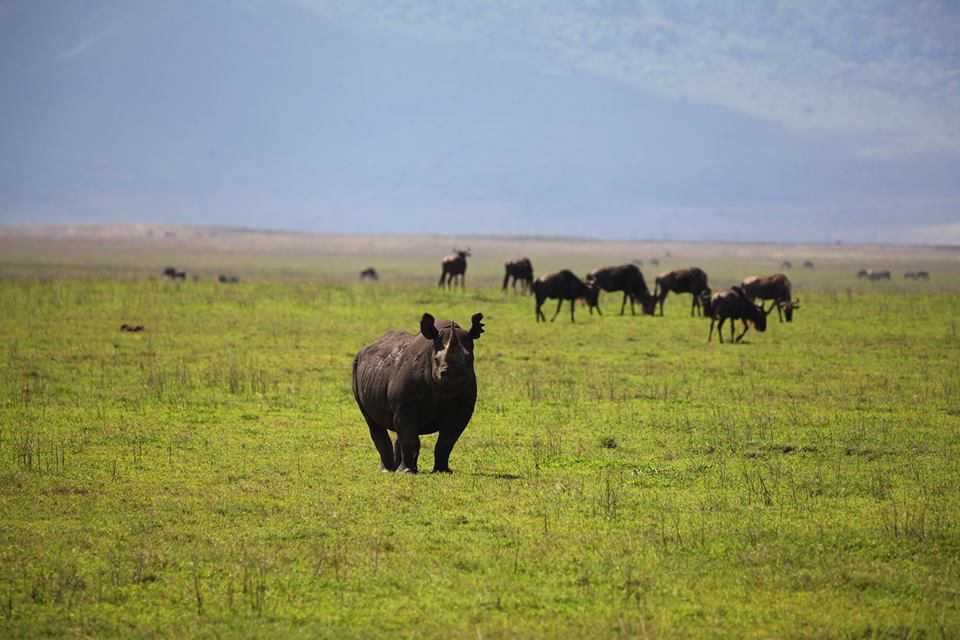
The Future of White Rhino Conservation in Tanzania
Ongoing monitoring and management, carried out by the Ngorongoro Conservation Area Authority, is key to the success of this project. Some of the rhinos have been fitted with tracking devices, and the protective measures already in place for the Ngorongoro Crater’s black rhinos have been extended to the new white rhino population as well.
This project is an important step towards the Tanzanian government’s long-term goal of establishing viable, genetically diverse breeding populations of white rhinos in Tanzania. A future second-phase translocation is planned, with the ultimate aim of moving 36 white rhinos to Tanzania. Tanzania’s Ministry of Natural Resources and Tourism hopes to create a breeding population that will one day serve as a source for introducing southern white rhinos to other protected areas in Tanzania.
Ongoing poaching risks and human-wildlife conflict are challenges that require close monitoring to ensure the success of this project and the future of white rhinos in Tanzania.
Seeing Rhinos in the Wild
The Ngorongoro Crater in Tanzania is the world’s largest unbroken caldera and measures 100 square miles. This reintroduction project means that there is now a chance to see both black rhinos and white rhinos inside the Ngorongoro Crater.
The Ngorongoro Crater has a population of roughly 20-35 critically endangered black rhinos inside the caldera. Following the reintroductions, there are southern white rhinos in Tanzania, also inhabiting the Ngorongoro Conservation Area. In addition to rhinos, the crater is also home to Africa’s densest lion population, and lots of other incredible wildlife such as hippos, zebras, elephants, wildebeest, and more!
We visit the Ngorongoro Crater on our Tanzania: Great Migration Safari. We stay at a lodge near the rim of the caldera so that we can get an early start and head down into the Ngorongoro Crater for the morning game drive to explore the Crater’s beautiful scenery and encounter the incredible wildlife. Join us for a safari and you may see rhinos in Tanzania!